Saturday, March 09, 2013

Thoughts on socialism

Socialism is one of those things that sounds great as a broad idea but once you start to get into the nitty gritty details falls apart pretty quickly.

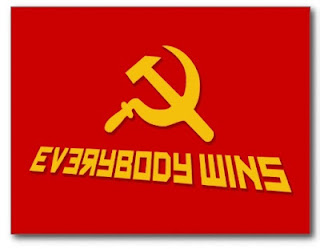
Socialism: Everybody wins
Source: Zazzle.co.uk

The biggest problem with socialism is that for it to work you need complete buy in.

Even if a small number of people in a society aren't completely sold on it it stops working.

Which is why for a socialist society to work you would need to start with the children.

You would need to start, in the nicest possible sense of the word, indoctrinating them at a young age so that once they become adults they couldn't conceive of society behaving in any other way.

And for those who indoctrination didn't work on, you would also need to be able to kick them out.

As I suggested earlier, it only takes a small number of people putting themselves ahead of society for socialism to break down, so when someone starts showing those signs you would need to remove them from society.

Which is one of the details that's makes socialism probably unworkable.

But doesn't mean we shouldn't at least try.

Does it?

Sunday, March 03, 2013

My Commander Shepherd - Mass Effect 1


The great thing about the Mass Effect trilogy is that while everyone who played the trilogy got the same story, each Commander Shepherd was different.
The decisions we all took were the same, but the reason for going down each path is unique to each of us.
 
Below is the story of my Commander Shepherd.
 
Commander Gopez Shepherd
 
Rescuing Kaidan Alenko or Ashley Williams during the Virmire mission
 
The first major decision in Mass Effect and the one that made me realise Mass Effect was going to be something special.
 
Speaking to Kaidan I always got the sense that what Kaidan went through for his biotic training had left a deep scar within him, one I thought he couldn't get over.
This, along with the medical issues he had, made me feel like Kaidan was a guy waiting to die.
 
Ashley always seemed like a racist to me, the type that wanted to blame their problems on something else, something preferably different to them.
It seemed easier to her to attribute the lack of success in her career to a conspiracy against her family because of her grandfather.
 
However, unlike with Kaidan I thought there was the possibility of redemption with Ashley.
If she spent enough time aboard the Normandy alongside a crew drawn from species across the galaxy she might see the error of her ways and learn to embrace diversity.
 
Because of this I chose to save Ashley over Kaidan - it almost felt like I was doing him a favour and giving him the release he craved. 
 
 
Sparing or killing Wrex during the Virmire: Wrex and the Genophage confrontation
 
This was an easy decision to make - there was no way I was going to kill Wrex.
 
Not only was he a really useful guy in a fight, but I felt a lot of sympathy for what the Galaxy had done to the Krogans (and it wasn't just the Salarians who should shoulder the responsibility for the Genophage; they might have created it but the Turians and Asari were happy enough to go along with it).
 
While what Saren was doing on Virmire might have looked like a cure to a desperate Krogan, what they were creating weren't real Krogans.
Even at that stage I felt the Krogans were capable of being more than just mercenaries, and that was in large part because of the conversations with Wrex.
 
If the Krogan were ever going to make their situation better, it would be because of people like Wrex.
It would have been a great loss to his people if he had died on Virmire, even if they didn't know it yet.
 
 
Sparing or killing the Rachni Queen on Noveria
 
I chose to spare the Rachni Queen, even though it wasn't clear what the consequences for doing so would be in later games.
 
I had two reasons for doing so, one being selfish.
 
In the same way I didn't think it was right to inflict the Genophage on the Krogan, they too had no right to cause another species to go extinct.
 
My second, selfish, reason was that I thought a species that almost defeated the combined might of the Turian, Asari and Salarians would be pretty useful to have around when the Reapers eventually showed up.
 
 
Deciding the fate of the Council during the battle with Sovereign, and the nomination of either Captain Anderson or Donnel Udina to the Council
 
While the council's inaction was infuriating, I felt no ill will towards them as they behaved in the way most politicians do; looking out for their interests.
However, when the Council came under attack and I had the option to save them or concentrate on Sovereign, I chose not to save them.
My thinking was that the fate of the galaxy was far more important than saving the Council and I didn't get the impression there were any particularly great leaders among the Council.
Looking back on it, maybe I felt that when these individuals were confronted with the biggest threat to galactic peace in tens of thousands of years and they chose to hide their collective heads in the sand, they were no great loss to the galaxy.
 
Stopping Sovereign was all that mattered at that point and I wanted to fleet to concentrate on that; I didn't think it was worth risking taking fire power away to save the Council.
 
The consequences of this decision in later games did take me by surprise though, and if I was given a chance to make it again I probably would choose differently.
 
Humanity took full advantage of both the power vacuum left by the deaths of the Council and of humanity's role in averting a galactic level threat.
 
I regretted that humanity would were so aggressive in the aftermath and I can fully understand why this left a bitter taste in the mouths of the other species, especially those who had been part of galactic politics much longer and still didn't have the influence humanity essentially took. It laid bare the worst of humanity and I wish we had shown more modesty, especially when you consider that while a human (Shepherd) was leading the force that finally uncovered what Saren was doing he was by no means along. Shepherd's task force was a cross-species one and it took the best of all of the galaxy's traits to avert the threat.
 
As for the choice between Captain Anderson or Udina to join the Council, this took no thought at all.
There are enough snivelling power hungry politicians in the galaxy already - there's no need to help one gain even more power.
 
When Udina betrayed the Council in Mass Effect 3 I couldn't help but feel vindicated for the way I had always viewed him.
 
"Romance" partner
 
Ah, the all important "romance"...
 
Why the quote marks? Because, and let's be honest here, when BioWare say "romance" they mean boning.
 
As I was playing a male Shepherd my choices were either Ashley or Liara, and I decided to go for Liara.
 
While I could see some redemption for Ashley, I still wasn't interested in having a relationship with a space racist.
Plus the way Liara described Asari sex, who could resist?
 
I'm guessing after I'd been with Liara I was probably too contaminated to interest Ashley anymore.


In the next part of this series I'll go through the decisions I made in Mass Effect 2.
You know, when I eventually get around to writing it.

Sunday, August 12, 2012

Why the World Doesn't Need Superman by Lois Lane


So several years ago I watched Bryan Singer's "Superman Returns".
The premise is that Superman leaves Earth, isn't seen for several years and no one knows when or if he'll ever return.
There was a scene where Lois Lane is discussing an article she wrote called "Why the World Doesn't Need Superman", and even wins a Pulitzer Prize for it.

I always wondered what an article like that would be, and eventually started to write one myself.

So after 6 years I finally finished it...

Why the World Doesn't Need Superman
By Lois Lane


If the beginning of this article sounds like an obituary, then that is by design.

We, at least as a city if not as a species, need to start getting used to the idea that Superman is never coming back.

He felt like a gift to mankind from Krypton, but in reality he was just on loan to us.

Actually, he was probably more of a management consultant; he came in when things were going wrong, he showed us what we need to do to put things right and then he left for another contract.

While I, as an individual who was lucky enough to spend time with Superman, will always be grateful for the things he did while on Earth, I am starting to believe that the world no longer needs Superman.

Those old enough to remember the time before Superman may think this a ridiculous notion, but let me put my case to you.

In the years Superman was active, crime in Metropolis reduced to almost zero levels, save for the occasional Super Villain plot.
Police spending dropped dramatically and the money saved was, with great wisdom, instead ploughed into new innovative education schemes.
These have helped keep crime levels low not just in the city but across the state as the governor followed the mayors lead and ploughed money into education.

So while most people can recognise a direct correlation between Superman's presence and the plummeting crime levels, we also need to attribute our impressive levels of literacy and education to Superman's influence.

But should it take the threat of a man with unimaginable powers to achieve these changes?

Superman didn't change our DNA. At our core we are still the same people we were before.
But what Superman did enable us to look beyond immediate concerns and look to the future.
He enabled us to examine the way we do things and to realise there may be better ways.

This may be the most important lesson Superman taught us.
That we shouldn't focus solely on solutions that might bring immediate results, that by taking a long term view, to be patient for results to emerge, we may finally go some way to dealing with the issues that seem too big to solve for our society.

Only then can we fulfil our potential.

Superman may be gone. He may not come back. But that doesn't mean we shouldn't feel his influence every day.

He has shown us the way and given us a taste of what we can achieve, and all that is required of us is the courage to embrace the new and to keep on this path even if results do not emerge immediately or at all.

Courage has never been being in short supply in Metropolis.

Superman wasn’t the only hero in Metropolis; he was just the only one who could leap tall buildings in a single bound.

How much courage does it take to face an assailant knowing that however strong they are or whatever weapons they carry, they are unlikely to be able to scratch you, let alone harm you? How much courage does it take to run into a burning building, knowing the flames cannot harm the costume you wear, let alone your skin? How much courage does it take to stand up for others, to put yourself in harm’s way to protect the innocent when you seem to be made of steel? Not much I would venture.

But how much courage does it take to face these challenges, when all you have to protect you is a vest made of Kevlar and a badge? A golden shield that represents all that our society stands for but wouldn't be much good at stopping a bullet?

All the courage in the world.

Metropolis may have lost a Superman, but it still has plenty of heroes willing to stand up for what is right and put their lives on the line for others.

The men and women of the Metropolis Police Department and Metropolis Fire Department may not get the headlines and front page pictures that Superman regularly received for his actions, but that doesn't mean they are any less deserving of our admiration.

In fact I would suggest that they are more deserving of it because they are not Superman.

And the same goes for their equivalents in every city, town and village in the world.

Why does the world not need Superman?

Because within each of us is a super man or woman already, but we can only realise this potential if we're willing to use it to help others and not ourselves.

We don't need to be able to stop a bullet if we make sure the bullet wasn't fired in the first place.

And we can only do that if we're willing to work together and embrace our differences, rather than let them separate us.

Superman once told me how his father described the human race:

"They can be a great people, they wish to be. They only lack the light to show the way. For this reason above all, their capacity for good, I have sent them you... my only son."

Superman has shown us the way, but that light has now passed to each and every one of us.

It is up to us how we use it.