Tuesday, March 14, 2017

Attributing value to the word "real"

“Nigerian novelist and feminist Chimamanda Ngozi Adichie has sought to clarify her position after sparking outrage with comments about transgender women that she made in an interview with Channel 4 News. The author of Half of a Yellow Sun came under attack after she failed to call transgender women “real women” in response to a question.”
The paragraph above from a Guardian article made me think recently about the value we attribute to the word “real”.

As someone who was born a man, I’ll never understand what it’s like to be a woman.
I can read all the books I want, watch TV shows written for women and read articles written by women but all this will get me is possibly an appreciation for what it’s like to be a woman; I’ll never actually know what it’s like to be born one.

Which is why I agree with what Chimamanda Adichie said:
“I think the whole problem of gender in the world is about our experiences. It’s not about how we wear our hair or whether we have a vagina or a penis. It’s about the way the world treats us, and I think if you’ve lived in the world as a man with the privileges that the world accords to men and then sort of change gender, it’s difficult for me to accept that then we can equate your experience with the experience of a woman who has lived from the beginning as a woman and who has not been accorded those privileges that men are.”
It's clear someone who was born a man then became a woman has experienced a different life to someone who was born a woman. However, I’d go even further than that because the experience of being born a white woman is different to being born a black woman, the experience of being a woman who is six feet tall is different to one who is five feet tall.

All of our experiences are different, even if in some ways they are similar.

The issue here is the use of the word “real” – claiming trans women are or aren’t real women is about attributing a value to one experience above the other.

Personally, I feel no experience is more authentic than the other; they’re all just different.

A trans woman probably can’t ever understand what it’s like to be born in a woman’s body, the same as someone born in a woman’s body can’t understand what it’s like to feel like you were born in a body which doesn’t correlate to your inner gender.

Tuesday, May 03, 2016

Thoughts on Pixar’s Inside Out

I recently watched Pixar’s Inside Out, which “is set in the mind of a young girl named Riley Andersen where five personified emotions—Joy, Sadness, Fear, Anger, and Disgust—try to lead her through life as her parents move from Minnesota to San Francisco and she has to adjust to her new life” (as described by Wikipedia).


It had some interesting ideas about how memories and emotions worked and really got me thinking, so I thought I’d write some of these down. Needless to say there will be spoilers.

One of the things I really liked from the movie was the idea of emotions being in control at different times, and there being one dominant emotion.

What resonated with me the most was that the dominant emotion goes a long way to determining our personalities. For instance, in the movie Joy is the dominant emotion as Riley grows up and therefore she’s a happy child. I’m sure we all know people who have different dominant emotions, from positive people, people who are constantly angry and those who seem to let everything get them down. However our personalities aren’t set in stone and if we start thinking about which emotion dominates we can consciously change our personality.

Another idea I hadn’t really considered before was that our memories have different emotions attached to them and that the emotion can change over time, especially as the memory itself changes.
For instance, a happy memory can change to anger if our feelings towards the person involved changes, or we look back at sad times in our lives and feel nostalgic for them as we forget the things which made us sad and only remember the good things.

Near the end of the movie Riley decides to get a bus back to Minnesota where she was happy.
The movie seemed to be suggesting that ideas can come from different emotions, in this example Anger came up with the idea. When deciding whether something is a good idea it’s worth considering where the idea is coming from. Ideas from anger and jealously for instance are rarely good ones.

Finally, at the end of the movie Joy and Sadness make it back to HQ and having spent most of the movie trying to keep Sadness out of the way, Joy let her take control.
It was only after Riley let herself feel her sadness and give in to it was she able to deal with what she was going through.
Although it’s generally good to try and stay positive, sometimes we need to give in to our feelings in order to process them and move on.


All in all, I got a lot out of this movie and made me view things differently; it was brave of Pixar and Disney to tackle a subject like this.

Friday, March 28, 2014

The Wild West vs the Modern World

There's a part in the game Red Dead Redemption where the main character, a bounty hunter by the name of John Marston, comes in from the  country into Blackwater,  a large and still growing city in the area.
Up until that point,  John Marston has spent most of his time in a fairly typical wild west environment; dusty towns,  mines and ranches.


Blackwater is the closet thing the game has to the modern world,  with it's paved streets, electricity and automobiles driving around.
In one mission John Marston finds himself in the back of one of these automobiles in his full cowboy gear.
It was watching this that it struck me that living in the West at this time must have been a strange experience.

On the one hand you still had most people using horses as their primary mode of transport, living in small towns and eking a living out of the land.
At the same time you started seeing national transport in the form of the railroads, which was helping create the beginnings of larger businesses.

John Marston finds himself between the two words, the rough,  dusty world of the stereotypical cowboy which he understood. A world where owning a gun wasn't a statement but more a necessity of serving.
The other world, the modern one with its rules, order and safety, was slowly creeping in.

It was thinking about what it must have been like to see the world change like this that made Mr appreciate what survivalists, bikers and ranchers are trying to hold onto in the modern world.

A sense of freedom, of being able to settle differences for yourself, not knowing what the next day would bring rather than the safe,  dull predictability of modern life.

While most people would prefer the safety of modern life over the anxiety and anarchy of freedom, when your alarm goes off on Tuesday morning at the same time it did on the Tuesday before and the Tuesday before that, you can definitely  see the appeal of frontier life.

Sunday, August 11, 2013

The day the Earth died


Once upon a time there was the Earth.

Well before that there was nothing, then a big bang, then eventually the earth.

Well, that's one theory, but it seems more likely than some bloke getting bored sitting around in the dark one day deciding to create the universe so he had something to fuck around with.
On this earth there lived some people.
A lot of people.
A hell of a lot of people.
Some would say, possibly too many people.
Which is probably why some of these people sat around writing stories about apocalypses, be they nuclear, zombie or pork related ones.

I could go into the pork related one, but then this would be an entirely different story.
So anyway, these people who lived on this earth, they decided one day that it would be a great idea that rather than eat their food raw, they should cook it.

So they invented fire.

And fire turned out to be awesome for a lot of things (warmth, cooking, clearing forests).

Buoyed by the success of fire, they then decided that being able to get around quickly would also be useful, so they invented the wheel.

And the wheel was also awesome.

Sometime later, someone decided tiny hats would be awesome.

No.


This is when shit started going wrong.

Very wrong.

Pork apocalypse wrong.

Saturday, March 09, 2013

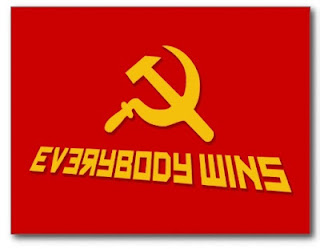
Thoughts on socialism

Socialism is one of those things that sounds great as a broad idea but once you start to get into the nitty gritty details falls apart pretty quickly.

Socialism: Everybody wins
Source: Zazzle.co.uk

The biggest problem with socialism is that for it to work you need complete buy in.

Even if a small number of people in a society aren't completely sold on it it stops working.

Which is why for a socialist society to work you would need to start with the children.

You would need to start, in the nicest possible sense of the word, indoctrinating them at a young age so that once they become adults they couldn't conceive of society behaving in any other way.

And for those who indoctrination didn't work on, you would also need to be able to kick them out.

As I suggested earlier, it only takes a small number of people putting themselves ahead of society for socialism to break down, so when someone starts showing those signs you would need to remove them from society.

Which is one of the details that's makes socialism probably unworkable.

But doesn't mean we shouldn't at least try.

Does it?

Sunday, March 03, 2013

My Commander Shepherd - Mass Effect 1


The great thing about the Mass Effect trilogy is that while everyone who played the trilogy got the same story, each Commander Shepherd was different.
The decisions we all took were the same, but the reason for going down each path is unique to each of us.
 
Below is the story of my Commander Shepherd.
 
Commander Gopez Shepherd
 
Rescuing Kaidan Alenko or Ashley Williams during the Virmire mission
 
The first major decision in Mass Effect and the one that made me realise Mass Effect was going to be something special.
 
Speaking to Kaidan I always got the sense that what Kaidan went through for his biotic training had left a deep scar within him, one I thought he couldn't get over.
This, along with the medical issues he had, made me feel like Kaidan was a guy waiting to die.
 
Ashley always seemed like a racist to me, the type that wanted to blame their problems on something else, something preferably different to them.
It seemed easier to her to attribute the lack of success in her career to a conspiracy against her family because of her grandfather.
 
However, unlike with Kaidan I thought there was the possibility of redemption with Ashley.
If she spent enough time aboard the Normandy alongside a crew drawn from species across the galaxy she might see the error of her ways and learn to embrace diversity.
 
Because of this I chose to save Ashley over Kaidan - it almost felt like I was doing him a favour and giving him the release he craved. 
 
 
Sparing or killing Wrex during the Virmire: Wrex and the Genophage confrontation
 
This was an easy decision to make - there was no way I was going to kill Wrex.
 
Not only was he a really useful guy in a fight, but I felt a lot of sympathy for what the Galaxy had done to the Krogans (and it wasn't just the Salarians who should shoulder the responsibility for the Genophage; they might have created it but the Turians and Asari were happy enough to go along with it).
 
While what Saren was doing on Virmire might have looked like a cure to a desperate Krogan, what they were creating weren't real Krogans.
Even at that stage I felt the Krogans were capable of being more than just mercenaries, and that was in large part because of the conversations with Wrex.
 
If the Krogan were ever going to make their situation better, it would be because of people like Wrex.
It would have been a great loss to his people if he had died on Virmire, even if they didn't know it yet.
 
 
Sparing or killing the Rachni Queen on Noveria
 
I chose to spare the Rachni Queen, even though it wasn't clear what the consequences for doing so would be in later games.
 
I had two reasons for doing so, one being selfish.
 
In the same way I didn't think it was right to inflict the Genophage on the Krogan, they too had no right to cause another species to go extinct.
 
My second, selfish, reason was that I thought a species that almost defeated the combined might of the Turian, Asari and Salarians would be pretty useful to have around when the Reapers eventually showed up.
 
 
Deciding the fate of the Council during the battle with Sovereign, and the nomination of either Captain Anderson or Donnel Udina to the Council
 
While the council's inaction was infuriating, I felt no ill will towards them as they behaved in the way most politicians do; looking out for their interests.
However, when the Council came under attack and I had the option to save them or concentrate on Sovereign, I chose not to save them.
My thinking was that the fate of the galaxy was far more important than saving the Council and I didn't get the impression there were any particularly great leaders among the Council.
Looking back on it, maybe I felt that when these individuals were confronted with the biggest threat to galactic peace in tens of thousands of years and they chose to hide their collective heads in the sand, they were no great loss to the galaxy.
 
Stopping Sovereign was all that mattered at that point and I wanted to fleet to concentrate on that; I didn't think it was worth risking taking fire power away to save the Council.
 
The consequences of this decision in later games did take me by surprise though, and if I was given a chance to make it again I probably would choose differently.
 
Humanity took full advantage of both the power vacuum left by the deaths of the Council and of humanity's role in averting a galactic level threat.
 
I regretted that humanity would were so aggressive in the aftermath and I can fully understand why this left a bitter taste in the mouths of the other species, especially those who had been part of galactic politics much longer and still didn't have the influence humanity essentially took. It laid bare the worst of humanity and I wish we had shown more modesty, especially when you consider that while a human (Shepherd) was leading the force that finally uncovered what Saren was doing he was by no means along. Shepherd's task force was a cross-species one and it took the best of all of the galaxy's traits to avert the threat.
 
As for the choice between Captain Anderson or Udina to join the Council, this took no thought at all.
There are enough snivelling power hungry politicians in the galaxy already - there's no need to help one gain even more power.
 
When Udina betrayed the Council in Mass Effect 3 I couldn't help but feel vindicated for the way I had always viewed him.
 
"Romance" partner
 
Ah, the all important "romance"...
 
Why the quote marks? Because, and let's be honest here, when BioWare say "romance" they mean boning.
 
As I was playing a male Shepherd my choices were either Ashley or Liara, and I decided to go for Liara.
 
While I could see some redemption for Ashley, I still wasn't interested in having a relationship with a space racist.
Plus the way Liara described Asari sex, who could resist?
 
I'm guessing after I'd been with Liara I was probably too contaminated to interest Ashley anymore.


In the next part of this series I'll go through the decisions I made in Mass Effect 2.
You know, when I eventually get around to writing it.

Sunday, August 12, 2012

Why the World Doesn't Need Superman by Lois Lane


So several years ago I watched Bryan Singer's "Superman Returns".
The premise is that Superman leaves Earth, isn't seen for several years and no one knows when or if he'll ever return.
There was a scene where Lois Lane is discussing an article she wrote called "Why the World Doesn't Need Superman", and even wins a Pulitzer Prize for it.

I always wondered what an article like that would be, and eventually started to write one myself.

So after 6 years I finally finished it...

Why the World Doesn't Need Superman
By Lois Lane


If the beginning of this article sounds like an obituary, then that is by design.

We, at least as a city if not as a species, need to start getting used to the idea that Superman is never coming back.

He felt like a gift to mankind from Krypton, but in reality he was just on loan to us.

Actually, he was probably more of a management consultant; he came in when things were going wrong, he showed us what we need to do to put things right and then he left for another contract.

While I, as an individual who was lucky enough to spend time with Superman, will always be grateful for the things he did while on Earth, I am starting to believe that the world no longer needs Superman.

Those old enough to remember the time before Superman may think this a ridiculous notion, but let me put my case to you.

In the years Superman was active, crime in Metropolis reduced to almost zero levels, save for the occasional Super Villain plot.
Police spending dropped dramatically and the money saved was, with great wisdom, instead ploughed into new innovative education schemes.
These have helped keep crime levels low not just in the city but across the state as the governor followed the mayors lead and ploughed money into education.

So while most people can recognise a direct correlation between Superman's presence and the plummeting crime levels, we also need to attribute our impressive levels of literacy and education to Superman's influence.

But should it take the threat of a man with unimaginable powers to achieve these changes?

Superman didn't change our DNA. At our core we are still the same people we were before.
But what Superman did enable us to look beyond immediate concerns and look to the future.
He enabled us to examine the way we do things and to realise there may be better ways.

This may be the most important lesson Superman taught us.
That we shouldn't focus solely on solutions that might bring immediate results, that by taking a long term view, to be patient for results to emerge, we may finally go some way to dealing with the issues that seem too big to solve for our society.

Only then can we fulfil our potential.

Superman may be gone. He may not come back. But that doesn't mean we shouldn't feel his influence every day.

He has shown us the way and given us a taste of what we can achieve, and all that is required of us is the courage to embrace the new and to keep on this path even if results do not emerge immediately or at all.

Courage has never been being in short supply in Metropolis.

Superman wasn’t the only hero in Metropolis; he was just the only one who could leap tall buildings in a single bound.

How much courage does it take to face an assailant knowing that however strong they are or whatever weapons they carry, they are unlikely to be able to scratch you, let alone harm you? How much courage does it take to run into a burning building, knowing the flames cannot harm the costume you wear, let alone your skin? How much courage does it take to stand up for others, to put yourself in harm’s way to protect the innocent when you seem to be made of steel? Not much I would venture.

But how much courage does it take to face these challenges, when all you have to protect you is a vest made of Kevlar and a badge? A golden shield that represents all that our society stands for but wouldn't be much good at stopping a bullet?

All the courage in the world.

Metropolis may have lost a Superman, but it still has plenty of heroes willing to stand up for what is right and put their lives on the line for others.

The men and women of the Metropolis Police Department and Metropolis Fire Department may not get the headlines and front page pictures that Superman regularly received for his actions, but that doesn't mean they are any less deserving of our admiration.

In fact I would suggest that they are more deserving of it because they are not Superman.

And the same goes for their equivalents in every city, town and village in the world.

Why does the world not need Superman?

Because within each of us is a super man or woman already, but we can only realise this potential if we're willing to use it to help others and not ourselves.

We don't need to be able to stop a bullet if we make sure the bullet wasn't fired in the first place.

And we can only do that if we're willing to work together and embrace our differences, rather than let them separate us.

Superman once told me how his father described the human race:

"They can be a great people, they wish to be. They only lack the light to show the way. For this reason above all, their capacity for good, I have sent them you... my only son."

Superman has shown us the way, but that light has now passed to each and every one of us.

It is up to us how we use it.

Sunday, August 22, 2010

Coaching? Bah! Just knock it up to the big man!

Henry Winter today on Sky's Sunday Supplement program opined that you can't teach a "football brain", you have to be born with it (he was referring to Theo Walcott, who over the last 3 seasons at Arsenal regularly made bad decisions on the pitch).


I think Henry Winter is talking about the mental parts of a footballer's skills, so things like positioning, anticipation, vision, decision making etc.
Personally, I think this is nonsense. Are we saying you can be taught "simple" things like quantum physics, but football? Christ, you've got to be born with it!
No wonder football coaching in England is so bad if an intelligent and influential journalist like Henry Winter has opinions like that.

Also, in my own experience I've found you can learn football how to play football, no matter your age.
People who know me will know how much I love football, but I only started getting into football relatively late, around 16 or 17 years old.
And around this time I also started playing football games like Pro Evo, which if you want to get good at requires you to have a good understanding of football.
When I started playing it, I was terrible; I'd choose teams like France (who were at that time the World and European champions) and play against teams like China (who are still pretty poor to this day). And I'd still lose. Badly.
But after a lot of practise, watching more football on TV and playing down the park, I eventually got quite good at it, and at my peak for a short time was probably the best player in my group of friends.

I'm not suggesting I've now got the mind of a football genius, but from where I started (having very little knowledge of football) to becoming a decent player (albeit on a video game), the actual knowledge is still very similar.

If someone has shown enough potential to get a professional contract at a big club, surely with hard work and patience you can improve their abilities?

Saturday, July 04, 2009

1 star cuisine

I've noticed recently that a lot of takeaways and restaurants have a sign on their door with their hygiene rating, ranked from 1 to 5 stars.

Whenever I see a sign with less than 5 stars, I can't help wondering what it takes to lose a star.

Is a cockroach worth a star? Or does it take a bunch of roaches? And what about rats - a rat's bigger than a roach so it wouldn't be fair for one takeaway to lose a star for one measly roach and another place loses the same number of stars for a rat.

Oddly enough it wouldn't bother me if a place had only 1 star; I'd probably be standing in the doorway munching on a salmonella infested, rat dropping laced burger while wondering how they lost their stars...

Sunday, December 21, 2008

Dancing With Controversy

So the final of Strictly Come Dancing was on this weekend, and with it came some controversy.
Though normally not a viewer (I have a dislike for any program which involves the public voting), I happened to see the end of the semi-finals the week before, where there were three couples dancing.


The normal procedure is for one of the couples to be eliminated and for there to be a final dance-off between two couples the next week.
However, this year it was decided all three couples would go through to the final. The next day it was revealed that the reason for this was that with the way the judges scored the couples, the top two couples were guaranteed to go through regardless of how many phone votes the couple in last place got.
Unfortunately the two hosts of the show didn't know this and encouraged the viewing public to phone in anyway to try and get their favourite couple through.
Due to the toughened up regulations on telephone voting, the BBC panicked and decided to let all three couples through, then add the votes that were cast to the final in addition to the phone voting which normally takes place (the judges do not cast votes in the final, the ultimate winner is chosen purely by public voting).

In the end, the couple who should have been eliminated in the semi-final went on to win and in my opinion completely stripped the show of any integrity it may have had (for this season anyway).
Possibly the greatest irony was that the winning couple, Tom Chambers (the celebrity) and Camilla Dallerup (the professional dancer) seemed to perform better than the runner ups and had the circumstances being different would almost certainly have deservered to win the compeition. Unfortunately in these circumstances the win was thoroughly undeserved and any records of the win should be accompanied by an asterix.

The reason I feel the win is undeserved is because the competition began with one set of rules, and because of a unique set of events (the judges scoring and the hosts urging people to phone vote) ended with another.

In trying to avoid punitive action from OFCOM, the BBC failed to protect the integrity of the show, which is far more important.
What they should have done was to donate any money made from the futile public phone voting to a charity to avoid accusations of defrauding the public and braved whatever punishment OFCOM dished out.
And in this case, OFCOM should have warned the BBC over it's conduct in the future but restrained itself from imposing a fine on them, or at least only imposing a suspended fine.

Because there is no material prize at the end of the show, all the entrants are competing for is pride - something that can mean far more to competitors than anything material.
The runners up this year didn't lose to a better competitor in the end, they lost to a unique set of circumstances and to me a loss that can be hard to understand and hard to accept.
Because of this my condolensces go out to Rachel Stevens and her partner Vincent Simone.


Wednesday, October 08, 2008

Bangs for your bucks

In the spirit of this credit crunch bargin bin era we currently find ourselves in, I found this album on the homepage of Napster today, a greatest hits album from Cypress Hill called Original Album Classics: Cypress Hill.

Consisting of 76 tracks over 5 discs, I had a quick look on Amazon.co.uk and was surprised to see it was going for a Lidl like £17.47 (which makes it super saver eligible, ching ching!).
I haven't seen a bargain this good since Valve's Orange Box compilation.

Update (21/12/08): Since making the world aware of this bargain, I've noticed Amazon has tried to take advantage of my sway with the public and pushed the price up to £18.57. I didn't realise I had such power...

Yes I have just signed up for an Amazon Associates account. Ching ching!

Monday, October 06, 2008

Hi, I'm a Mac and I mislead people

Full disclosure: This was written on a Windows PC.

I recently watched some of the US "Macs vs PCs" ads on YouTube (embedded below - probably worth watching before reading the rest of this post), and a few of them really annoyed me.


They are funny, and the concept behind the ads (PCs for work, Macs for the home) is a good angle for Apple to take. However, I don't understand how these ads are/should be legal, because from my viewpoint some of the points they make are either factually wrong or misleading.

My first bugbear is Apple's usage of the term "PC".
As I understand it, PC stands for Personal Computer, which Wikipedia defines as “...any computer whose original sales price, size, and capabilities make it useful for individuals, and which is intended to be operated directly by an end user, with no intervening computer operator.”

This definition, which most people in the IT industry would agree with, can apply to computers running Windows, Linux and of course Mac OS. In fact the Apple PC was one of the first mass market PC's and Apple are often credited with helping kick start the home PC revolution.
What Apple means by “PC” in their ads are computers which run Windows. They don't want to come out and say Windows, because, as I said earlier, some of their claims are either factually wrong or misleading. If they did say Windows, then Microsoft may be able to sue them for something. But by using a generic term like “PC” Apple seem to think they can claim anything they'd like and they'd get away with it (which to be fair they seem to have done).

If you skip to about 09:07 into the embedded video above, one of the ads start with the Mac claiming that he's into fun stuff like “movies, music and podcasts” and the PC claiming that he too can do fun stuff like “time sheets and spreadsheets and pie charts”.
The Mac then goes on to say that “it would be kinda difficult to capture a family vacation on a pie chart”. To me, this seems to be misleading, as the suggestion is that only the Mac can do things like “movies, music and podcasts” or handle holiday photos, which is a lie.

There are other misleading suggestions in the ads, such as Windows PC's are better suited for work environments and Macs are better for homes, that Macs handle creative tasks better than Window's PC's. This is misleading as there are very few third party applications on the Mac that aren't available for Windows, while there are hundreds of PC games released each year for Windows and very few for the Mac.

Apple, fan boys aside, make some really good products. iPods helped make portable MP3 players truly mainstream and the iPhone have shown other handset manufacturers how smart phones should be designed, so it baffles me that Apple would need to resort to such dirty handed and disgusting tactics – maybe it's Mac who's insecure about his capabilities and not “PC”.

Monday, April 28, 2008

American reactions to 9/11

I was reading an article today in Wired magazine (this one) about a woman who had just become head of IARPA, a government agency tasked with outfitting US spies with advanced technology.

The part I found interesting was the reason she gave for switching from academic work to government work:

Like many Americans," she says, "I felt a need to step up and contribute."

It seems to me her thought process was "We were attacked, how can I help retaliate?". Now, she isn't unique in thinking like this as I've heard multiple stories of people joining the military after 9/11, but I do find it interesting that there weren't more Americans who didn't instead think "Why were we attacked?" or "What was it about us that made someone want to go to such lengths to inflict pain?"

Tuesday, April 22, 2008

Why we need net neutrality

Last week several UK ISPs banded together to tell the BBC that their iPlayer application was "overwhelming" their networks, and that unless the BBC pay them to increase their network capacity they will start throttling the traffic being sent over their networks by iPlayer.

In the same week, in an interview with the Royal Television Society's Television magazine, Neil Berkett (the new CEO of Virgin Media) attacked the concept of net neutrality describing it as a "load of bollocks".

For those not familiar with the term (net neutrality, not bollocks), Columbia Law School professor Tim Wu defines net neutrality as "the idea is that a maximally useful public information network aspires to treat all content, sites, and platforms equally."

What the issue essentially boils down to is that ISPs around the world are starting to see an increase in the traffic being sent across their networks as bandwidth hungry applications like Bittorrent and video on demand (VOD) services break into the mainstream.

Rather than investing money in their network infrastructures themselves, ISPs seem to have banded together to try and get content providers like the BBC to pay for it instead.

Whether net neutrality is right or wrong is a side issue, as the idea of content providers having to pay ISPs to upgrade their networks is ridiculous, comparable to expecting car manufacturers being asked to pay to build more roads.

In the interview with Television magazine, Neil Berkett claims Virgin Media are already in talks with several content providers about paying for a priority service over their network.

As someone who's a supporter of net neutrality, this worries me, and using the following analogy I’ll explain why:

Firstly, imagine a scenario where you have two companies who both produce video podcasts about technology.

One is a small start-up with limited funding (let's call them Web Start-up) and the other an existing media company with deep pockets (we'll call them Old Money).
Because Web Start-up has limited funding, they are unable to pay Virgin Media for higher priority across their network but Old Money can so they do.
In this example whenever users on Virgin Media's network try to watch Web Start-up’s video podcast streaming online they find they can only watch a few minutes at a time before it pauses to re-buffer the video.
Because Old Money is paying for a higher priority their viewers don’t experience this problem.
Without even considering the content of the two podcasts, Old Money’s viewers are getting a better experience and therefore more likely to keep viewers.

This gives Virgin a lot of power, which could then be abused. This brings me onto my second point.

Now let’s imagine that despite the setback Web Start-up faced, they produce a podcast that’s so good they get significant numbers of viewers.
It’s possible that Old Money can approach Virgin and agree a deal that on top of just giving Old Money a higher priority service across their network they also agree to shape traffic in a way that also further deteriorates competing services, such as Web Start-up’s.
While competition law would make it difficult for the contract to state it in these blatant terms, I’m sure a good corporate lawyer would find a way around them.

Finally, my last point covers why even Old Money should be for net neutrality.

Even if Old Money pays Virgin Media, this would only cover Virgin Media's customers. Old Money would also have to pay every other ISP who charges for higher priorities, possibly including those from the rest of the world, to be able to provide a good service to their subscribers; the cost of this could be astronomical and probably prohibitive.
Instead of money being used to produce better content, this money goes to ISPs to basically pay for the fact their networks cannot cope with the demand their customers are putting on it.

I hope I have demonstrated that when you start charging content providers for bandwidth services, you start getting into some very murky areas.
I also believe that when you force content providers to play on a level playing field you force them to make better content, which we can all agree can only be a good thing.

Wednesday, October 10, 2007

Chris Rock Quote

Something I saw Chris Rock say during a stand-up show:

A black C grade student can't even manage a Burger King, but a white C grade student is the President of the United States of America...

Probably not true (I'm sure Bush dreamed about getting C grades) but funny nonetheless.

Wednesday, September 26, 2007

Re: 'No one stops the ball: it's all shoot, shoot, shoot'


I thought I'd post this reply to an article from the Guardian Unlimited website.

My first (over) reaction to Carlos Bilardo's views was "b*ll*cks, this guy's a moron", especially when he said "I honestly think these teams would struggle to fight for third or fourth position in Argentina".

But after thinking about it, I think I can understand the point he's trying to make (although I still disagree The Big Four would struggle in Argentina, especially if the climate wasn't a factor).

The points he seems to be making (judging from the couple of quotes the writer has used, who knows what else he said?) is that English teams lack technique, and that because of this the football is either not as effective as Argentinian football (hence the "these teams would struggle to fight for third or fourth position in Argentina" remark) or that it not as enjoyable to watch.

I would concede that teams overall in the Premiership aren't as technical as their counterparts in other leagues; however you still need certain abilities (or put another way, talents) to make it in the Premiership, such as pace, strength, quick thinking, which not all players have.
Because of this there have been talented players who have struggled in the Premiership because they lack some or all of these abilities.
The best example of this is probably Veron, arguably a great player in Argentina and Italy, he just couldn't cope in the Premiership because he needed more time and space to influence the game, something he couldn't get in the Premiership. Other examples include Forlan (another South American) and more recently Shevchenko; I definitely believe if Shevchenko had stayed in Serie A he would still be banging in the goals today, but in the Premiership he looks less than half the player he once was.

This style of football is usually exemplified best by teams like Blackburn, Bolton (under Allardyce), and to an extent Chelsea (I say to an extent because Chelsea, under Mourinho, were far better tactically and technically than the others).

I've watched these teams regularly beat far more technical Arsenal teams, even in matches Arsenal have dominated through their technique.

Bilardo also says "If you watch English football, what they do well is delivery from the defence to the midfield. But the tendency is always to return to the area. And no stopping, no one stops the ball. It's all shoot, shoot, shoot... From here to there, from the first minute to the 90th, all running, running, running. One touch, gone. A touch, gone. It's like tennis."

While there are some matches in the Premiership that leave a lot to be desired, I personally feel that when football is played one touch at a high pace (which teams like Arsenal and Sevilla do, two of the most admired teams in Europe), football is far more enjoyable than some of the strolling, pass-pass-pass football Channel 5 showed last year from Argentina.
And interestingly, it actually takes technical players to be able to play fast one-touch football, which makes Bilardo's comment a little confusing.

He also made this comment on the weekend after he saw a player that does stop the ball, and does so regularly: Cesc Fabregas.
All last year and this year I've seen Fabregas take a ball from the midfield, move it sideways from an opposition player to buy a little time, look up and then hit a glorious 30 yard ball to a player making a run ahead of him.
I can't remember if he did this against Derby (he did make a couple of very good long passes to Adebayor, but can't remember if he actually stopped the ball as Bilardo demands).

Finally, a little off the original point, but this excerpt from sampras14's post got me thinking:
"probably because of the many foreign manager and EPL have become a much better league to watch even if the EPL still have a lot to learn from the Serie A about tactics and from the Primera about technical skills. These two leagues could, in turn, learn a lot from the EPL about pace and strength..."

This is the great thing about European club competitions like the UEFA Cup and the Champions League (for all it's elitism); they go beyond just a clash of countries but also a clash of footballing styles - Italian tactical nous vs. Spanish technique vs. English physicality.

Football is certainly a sport that encourages stereotypes...

Monday, August 20, 2007

God Hates Shrimp!

Little known fact: God hates shrimp.


According to Leviticus 11:9-12:

These shall ye eat of all that are in the waters: whatsoever hath fins and scales in the waters, in the seas, and in the rivers, them shall ye eat.
And all that have not fins and scales in the seas, and in the rivers, of all that move in the waters, and of any living thing which is in the waters, they shall be an abomination unto you:
They shall be even an abomination unto you; ye shall not eat of their flesh, but ye shall have their carcases in abomination.
Whatsoever hath no fins nor scales in the waters, that shall be an abomination unto you.

I stumbled across this website by accident, but before the religious fanatics start mobilising, the site isn't really about God hating shrimp, it's more about how there's a lot in the old testament that doesn't apply anymore, and that the new testament put down a new set of rules.
They use this as a basis to suggest that God isn't actually against homosexuality, because according to the site Jesus never spoke out against it.

Interesting stuff, read the about section for more information on the site.

Sunday, July 22, 2007

For I am

I close my eyes
I hear my breathing
I feel my mind clear
And I hear pain and suffering
For I am the world

As I concentrate
I hear people crying
I feel their fear and hopelessness
I hear the world avoiding looking at me
For I am Darfur

As I concentrate
I feel violence within me
I hear myself attacking someone
I feel their possesions in my hand
And I feel I have no choice
For I am the cycle of crime

As I concentrate
I feel the temperature of the world increasing
I hear another piece of the ice cap fall into the sea
I feel the pollution pouring into the skies
And I feel those in power counting votes
For I am climate change

As I concentrate
I feel people who care
I hear them want to make a difference
I feel the desire to be better people
And I hear them continue to fight a losing battle
For I am human potential

Saturday, June 02, 2007

C:\My Documents\My Football Club

I first read about this site in an article on the BBC Sport website.

The idea of the website, My Football Club, is that members sign up and pay £35 a year to buy an equal share in a football club.

What makes this idea different to a club owned by a Supporters trust is that each member gets an equal vote on almost every aspect of the running of the club, from picking weekly formations, transfers to staff appointments, all backed up by reports from the head coach, videos of training and matches etc.
There won't be a manager as the members will in effect be both the manager and chairman (in a Football Manager kind of way).

The driving principle behind the idea is for football fans to be more involved with football in an age where some fans feel alienated by millionaire footballers, expensive ticket prices and hostile take over bids for clubs.

The site is waiting for at least 50,000 people to commit to paying £35 (which will give a purchase fund of £1.375 million) and when this is received members will vote on which club to try and purchase; the most popular choice at the time of writing is Leeds United.

I've already registered for the site as I think it would be an interesting project to the involved with.

So far 31,479 people have registered an interest - will you be 31,480?

Links
My Football Club website
BBC Sport article: Fans given club takeover chance

Ban on gay men giving blood? WTF?!

I learnt an interesting fact today: Despite the shortage of blood donors, gay men (or men who have ever had intercourse with another man) are discouraged in the UK from being blood donors and are actually banned in the US.

From what I've read, the reason is that men who sleep with other men are a high risk for HIV.
While on the surface this seems to be a sensible and valid argument, it ignores the fact that HIV is now widespread in the general population and not just limited to the homosexual community; this isn't the 80's any more.

Screening for HIV these days is supposed to be very accurate and can take just a matter of days to test, so the risks of getting infected blood is probably very small.

Personally I feel the ban is an example of institutional homophobia.

What do you think?

If you want more information follow the link to an article on Gaylife.About.com in the references which has more information (though does seem biased towards the gay view point).

References:

Nation Blood Service information on who can't give blood
Gaylife.About.com article: Gay Blood and Bone Marrow Donors